Zientzia eta Berrikuntza- Science & Innovation

I am a Doctor of Philosophy (I have a PhD degree). That means I am very curious and like to discover things. Also that I do philosophy with the things I find. So here, you can find my philosophies of science:
In this journey I transited from geology, glaciology, biogeochemistry, to molecular biology and microbiology, and to material sciences and engineering. Also through countries such as Spain, Sweden, UK, Svalbard (Norway), New Zealand and the USA. Also through science to entrepreneurship and advocacy.
What a ride.
Limited, Powerful, Beautiful and Meaningful
Science is a powerful tool to discover the Natural World. It also falls short in discovering what's out there. I still love it to a point. I have been doing it for years. Academically, since 2006 when I started my licentiate in geology. A trip to Kiruna during my Erasmus Scholarship in Uppsala (Sweden) directed me to protect the frozen world. I went out to Sheffield University (UK) to study my masters in Polar and Alpine Change, where I spent a month in Svalbard (Arctic Norway). Then to Durham University (UK) to study my PhD in ocean-climate and ice-sheet interactions studying ancient marine sediments. I continued going to the Arctic to assist teaching and Arctic fieldwork yearly for physical and social geography undergraduate students in Tromso and abouts (Finnmark), looking at glaciers, geomorphology, lichens and talking to sami tribes.
Studying the Past - Understanding the Future
I study lipids in marine old sediments to understand “warmer worlds”of the Earth History, and with those, understand our inherited future climate from increased warming due to burning fossil fuels. These lipids are remains of microbes, plants and animals. They are organic fossils, and what we do is to understand where did they come from, how and who produced them to reconstruct the marine ecosystem, ocean and wind patterns, and the ecology and diversity of the place. In the pictures below you see me on a cruise in the Arctic Norway, and some colourful lipids I extracted in the lab.

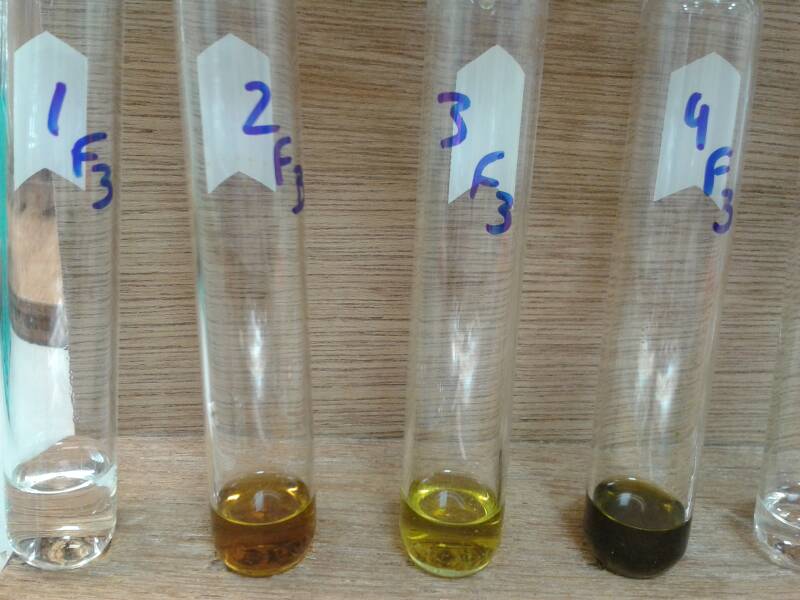
Here are some of my contributions to science:
Late Pliocene Cordilleran Ice Sheet development with warm northeast Pacific sea surface temperatures
- How Cordilleran Ice Sheet grow? Warm SSTs, water column more stratified, more aquatic productivity.
- Warm SST accumulation in the NW Pacific (ODP 1208 and ODP 882) that shifted northwards during the intensification of the North Hemisphere Glaciation (ODP 882 and U1417), around
- Northward transport of moisture important for glaciation
- Increase of AL strength during the MPWP and iCIS
Ocean warming, icebergs, and productivity in the Gulf of Alaska during the Last Interglacial
- MIS 5e: Warmer and saltier, change of coccolithophore producers, high iceberg discharge.
- ACC reduced?
-
Warm SST accumulation in the subarctic Pacific (ODP 882 and Site U1417) that decreases after MIS 4 (?).
-
Productivity in the ocean changed with latitude – ocean circulation- atmospheric circulation-nutrient- productivity and climate interactions .
-
More degassing in northern latitudes and more drawdown in southern latitudes?
- The NE Greenland glaciers have previously collapsed under 2∘C warming.
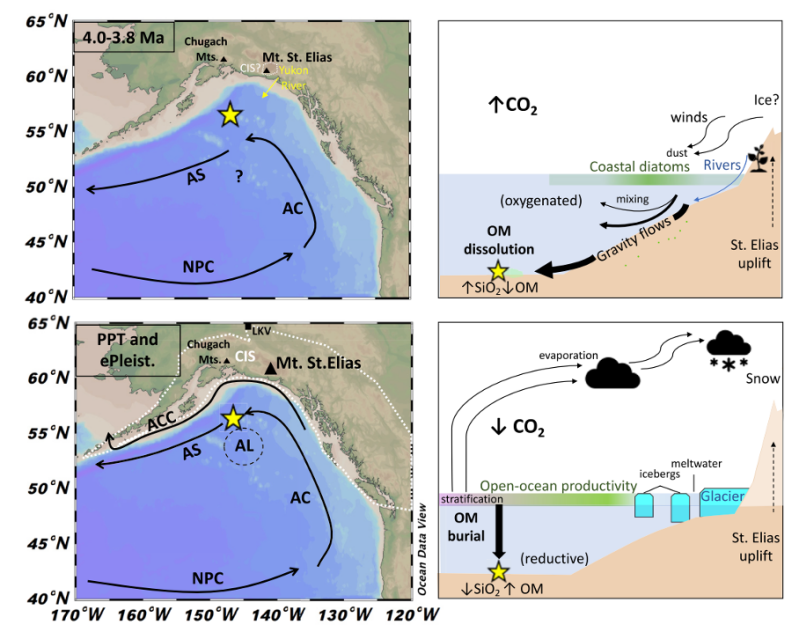
Biomarkers can reveal details about the environment that other climate proxies are not able to pick up, either because of their preservation or because the proxy limitations (e.g. relate to specific organisms). The combination of different proxies is a good approach to understand the preservation or production origin and the differences across proxies.
Innovating Materials from Nature for Industry Applications
After adding data points to our understanding of the Climate Crisis and informing policy makers, I experimented first hand the different pace of climate, research and policy. Who is winning? Climate change. I needed to do something - and the question was not burn-out conducting research (that's where I was). It was a career that had a speed that could catch up with the Climate Changes.
I decided to put my efforts into where I could have the impact needed in the world at the time that is needed. I pivoted my career into Climate Solutions with industry applications. For example, making sustainable concrete, because concrete is one of the most CO2 emitting materials we use.
Something I'm enjoying deeply recently is experimenting with microbes and creating materials - same materials as in the mud and the oceans, just put into a lab and see what properties they have and how to integrate them into the manufacturing pipeline. For example in the pictures below, I cultured some organisms that you can see under the microscope and test them to heal concrete.


Entrepreneur - Carbon Sequestering Clothing Start-Up
As part of this adventure, I started a venture, that develops carbon sequestering textiles for the apparel industry. Same concept, let nature do the materials that are known to her and do not damage her.
I started talking to people beyond academia, to Climate Advocates and citizens looking for change.
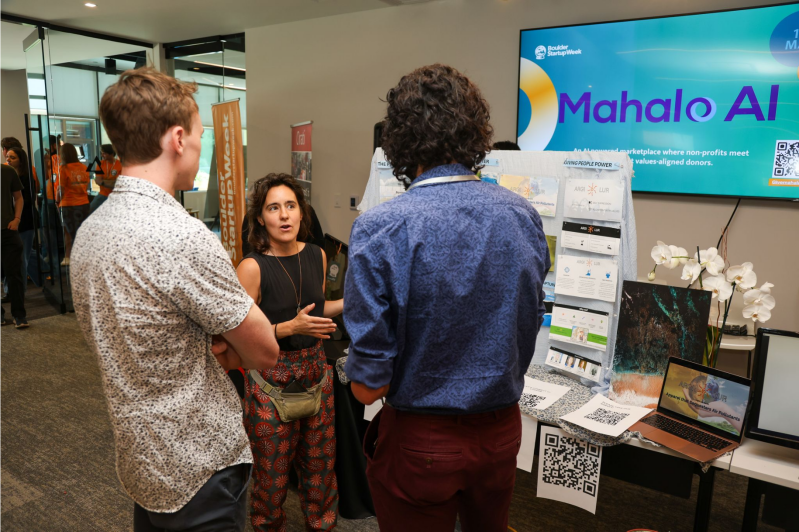
Improving the Academic System Leadership from the Heart
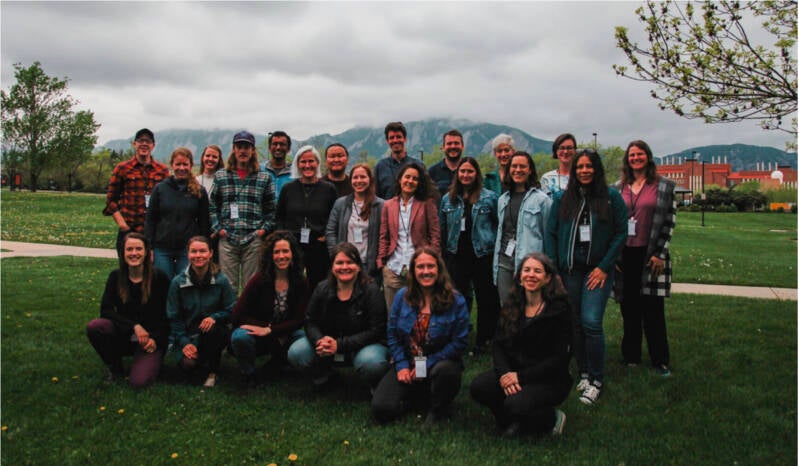
I work on improving the future academic leadership in polar research. I often find myself being the only women in a research group, enduring work environments where I do not receive a proper professional treatment. When this photo was taken, I was in that kind of work environment. Luckily this leadership workshop was full of fantastic women.
This is a publication from that workshop:
Postdoc Perspectives on Leadership and Matters of Equity and Inclusion in Polar Science
Education Commitment
Science with a mission: to be publicly owned.
Part of my ethics is to publish in open source format for the wide public to be able to access my research outputs.
Another part is outreach to make the science reach everyone, by teaching teachers in schools about climate science and make women visible in science.
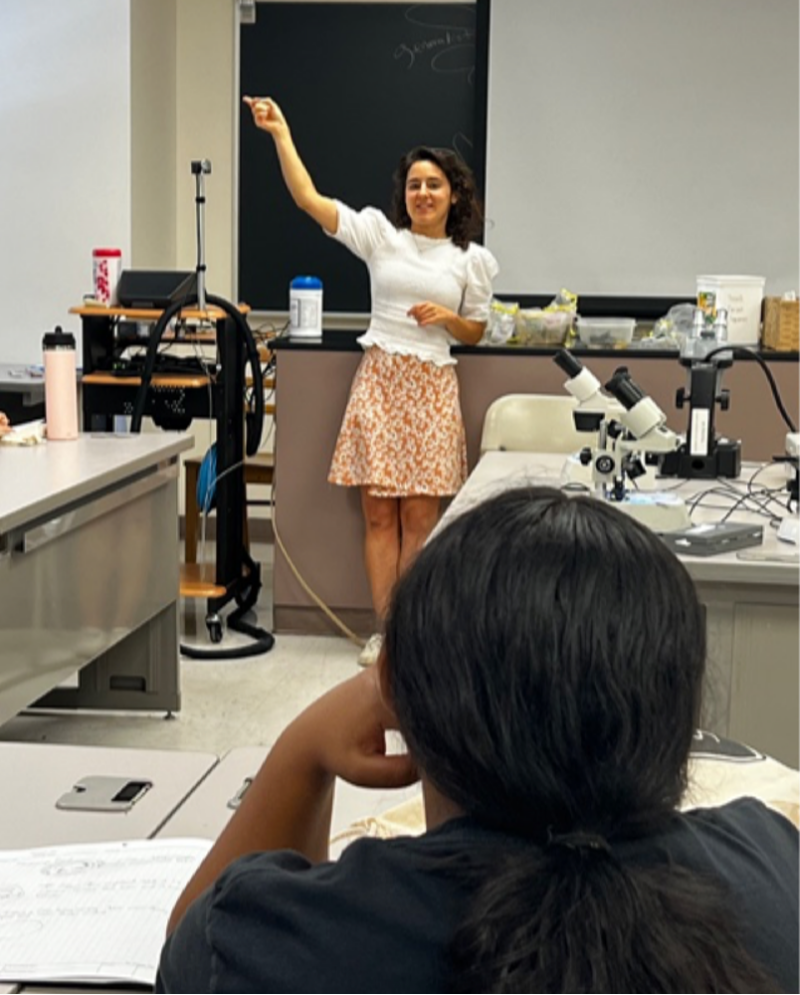

In these pictures you see me teaching teachers in underserved communities in Colorado and inspiring girls to pursue careers in STEM.